
Technical Highlights

  • Impedance measurement from 1 Hz to 20 kHz, for high-resolution data.
  • Integrated calibration resistor, robust aluminum housing.
  • Higher output, better signal-to-noise ratio, more accuracy.
  • More technical details
Regular price €145.45
Regular price -27% €199.00 selling price €145.45
2% discount with credit card
including VAT
Expected Sep 14 to Sep 17 with you.
x piece
  • American Express
  • Apple Pay
  • Bancontact
  • BLIK
  • EPS
  • Google Pay
  • iDEAL Wero
  • Maestro
  • Mastercard
  • MobilePay
  • PayPal
  • Shop Pay
  • Twint
  • Union Pay
  • Visa
datasheet
Regular price €145.45
Regular price €199.00 selling price €145.45

Product description

DATS V3 is a Measuring Device from Dayton Audio with a compact, robust aluminum housing and a built-in, easily accessible calibration resistor. The computer-based test and measurement system captures electroacoustic parameters and impedance in loudspeaker systems. A linearity test allows for the analysis of shifts in parameters at different signal levels. A higher output produces a better signal-to-noise ratio and enables greater accuracy. Data points from 1 Hz to 20 kHz support high-resolution impedance measurement. Additionally, it has the capability to capture parameters of the Wright model: Kr, Xr, Ki, and Xi.

Features
  • Measuring Device
  • Compact and robust aluminum housing
  • Built-in and easily accessible calibration resistor
  • Linearity test for analyzing shifts at different signal levels
  • Higher output for better signal-to-noise ratio and greater accuracy
  • Impedance measurement with data points from 1 Hz to 20 kHz
  • Capability to capture Wright model parameters: Kr, Xr, Ki, Xi
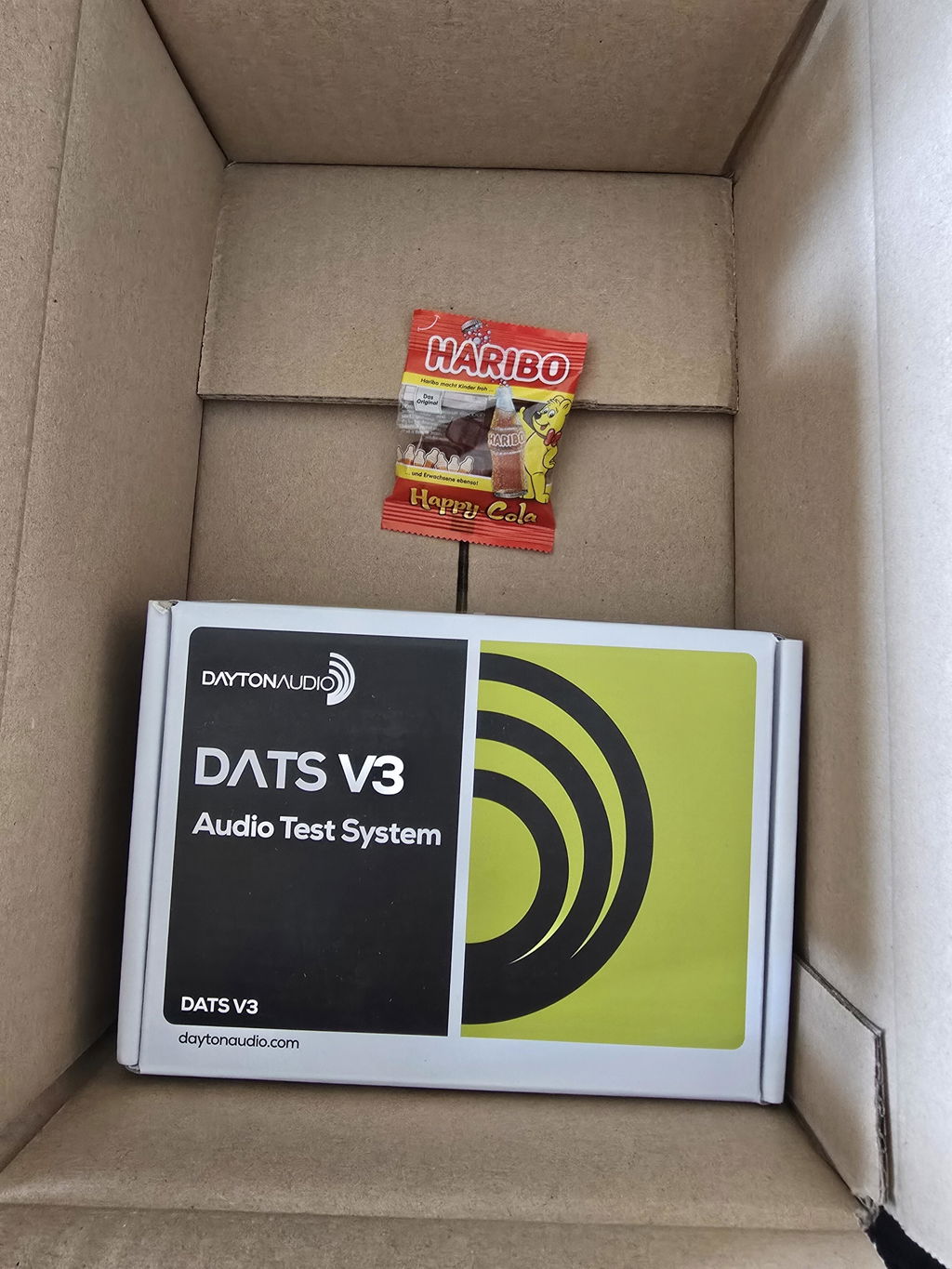
  • Computer-based test and measurement system for electroacoustic parameters and impedance
  • Included: DATS V3 measuring interface, USB cable, alligator test leads, instructions for downloading the software, and quick start guide
Technical Specifications
  • Frequency range of impedance measurement: 1 Hz to 20 kHz
  • Housing material: aluminum
  • Built-in calibration resistor
  • Linearity test for assessing parameter shifts
  • Capture of Wright model parameters: Kr, Xr, Ki, Xi

datasheet

Open data sheet

Frequently Asked Questions about DATS V3


How exactly does the DATS V3 capture electroacoustic parameters?

The DATS V3 test and measurement system from Dayton Audio enables precise capture of electroacoustic parameters by performing high-resolution impedance measurements over a frequency range of 1 Hz to 20 kHz. It utilizes a computer-based approach that allows for detailed analysis of the conversion between electronic signals and acoustic output. Especially when you want to fine-tune and optimize your speaker system, the linearity test of the DATS V3 provides an analysis of shifts at various signal levels. It delivers a better signal-to-noise ratio, further enhancing the accuracy of the measurement results. These innovative features make it an essential tool for ambitious audio engineers.

What distinguishes the DATS V3 from other impedance measurement devices?

The DATS V3 is primarily distinguished by its compact and robust aluminum housing, which makes it ideal for demanding applications. Its integrated features, such as the calibration resistor, facilitate precise measurements. The ability to capture parameters of the Wright model, such as Kr, Xr, Ki, and Xi, opens up advanced analysis possibilities for you. These parameters are crucial for understanding complex electroacoustic systems. Comparable devices rarely offer this combination of hardware reliability, extended functionality, and ease of use. Especially in demanding projects, the higher output for a better signal-to-noise ratio is a significant advantage.

What role does the aluminum housing of the DATS V3 play?

The aluminum housing material not only gives the DATS V3 from Dayton Audio high resistance to mechanical influences but also ensures reliable shielding against electromagnetic interference. Especially on construction sites or in laboratories where different electronic devices operate, interference-free operation is a great advantage. The compact design also allows for easy transport, which is practical for mobile applications. In addition to robustness, the housing also plays a role in temperature management, increasing the longevity of the internal electronic components. Thus, the aluminum housing combines functionality and protection in an appealing design.

How does the linearity test of the DATS V3 improve measurement results?

The linearity test of the DATS V3 allows for a deeper analysis of parameter shifts at various signal levels, which benefits you when tuning speaker systems. It takes into account the nonlinearities that can occur at different volume levels, enabling a more precise adjustment of speaker performance. Especially when you aim to achieve the best sound quality, the test provides the opportunity to detect subtle errors that might be overlooked by traditional measurement methods. By combining these results with the comprehensive frequency range, the DATS V3 draws accurate conclusions that can be crucial for measurements.

What advantages does capturing Wright model parameters with the DATS V3 offer?

Capturing Wright model parameters such as Kr, Xr, Ki, and Xi with the DATS V3 provides you with enhanced insight into the behavior of speaker systems. These parameters describe complex interactions in the electroacoustic domain that are essential for detailed system analysis. Such information is vital for the design and optimization of speakers. Particularly when you want to trace specific changes in electrical behavior, these parameters are highly beneficial. They help you understand the resonance and damping characteristics of the system more accurately, allowing you to derive optimization steps.

How does the signal-to-noise ratio affect measurements with the DATS V3?

The improved signal-to-noise ratio of the DATS V3 leads to more accurate measurements by effectively minimizing background noise. This is especially important when you want to perform precise impedance measurements to analyze the electroacoustic properties of your system. A higher signal-to-noise ratio means that the signals received by the device are clearer and less obscured by interference, which is crucial for analysis. The ability to obtain clean measurement data across different frequency ranges clearly sets the DATS V3 apart from other measuring devices. This is a critical technical factor for accurate, repeatable results.

What is the significance of the frequency range from 1 Hz to 20 kHz for the DATS V3?

The frequency range of 1 Hz to 20 kHz that the DATS V3 can cover allows for detailed impedance measurements that include both low and high frequencies. This bandwidth is necessary to evaluate the full spectrum of human hearing and to comprehensively analyze electroacoustic systems. Especially in high-frequency technology, where precise measurements are essential, the DATS V3 shows its strength. The wide frequency range is also helpful in identifying irregularities or mismatches in the speaker across the entire audible range, which can be crucial for optimizing audio systems.

How easy is the installation of the DATS V3 in the car?

Since the DATS V3 is equipped with a compact and robust aluminum construction, it can be easily installed in vehicles. Note that no specific car brands are mentioned, which means universal compatibility is assumed. The exact dimensions and the included accessories such as USB cables and alligator test leads support flexible mounting and use in mobile applications. The placement should be in an area that ensures safe access to the measurement connections. This way, you ensure that the device is securely mounted and can provide reliable measurements.

What are the advantages of the built-in calibration resistor in the DATS V3?

The built-in calibration resistor of the DATS V3 offers you the advantage of quickly and easily verifying and calibrating measurement results on a standardized basis. This significantly contributes to measurement accuracy and makes the device particularly valuable for repeated measurements between different sessions. For you, this means that deviations due to environmental influences or device room temperatures can be minimized. With the calibration resistor, you greatly increase the consistency of your results, which is necessary for reliable long-term analyses of critical measurement data. This saves time and increases efficiency in your work.

How does the DATS V3 support high-frequency impedance measurement?

The DATS V3 from Dayton Audio supports high-frequency impedance measurements through its ability to sample and display data points from 1 Hz to 20 kHz. Especially for more complex tasks in the audio field, where high-frequency behavior needs to be analyzed, this measuring instrument offers clear advantages. Through detailed sampling and evaluation, it enables you to precisely identify frequency dependencies. This is essential for applications where frequency responses need to be critically analyzed and optimized, such as in speaker development or acoustic diagnostics in the studio and event design.

Manufacturer information/responsible person

Audio Components BV
Koen Pronk, Martijn Ouwerkerk
Peizerweg 97a
9727AJ Groningen
Netherlands


Contact: info@audio-components.com